The amplifier can live anywhere
Analog audio wants short cables. Dante travels as far as the network does, so an amplifier can sit in a pool house, a barn or a second rack, with one network or fiber link back to the main house.

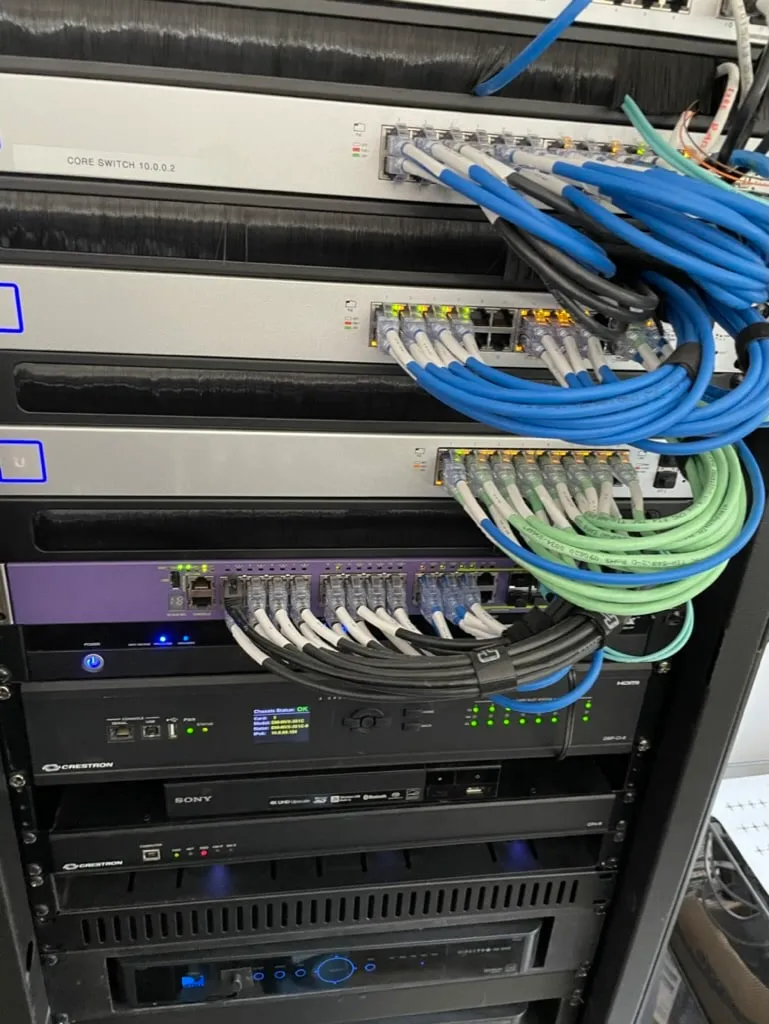
Amplifiers/Dante
Dante audio networking · Santa Barbara
Dante moves audio over the building's network in place of analog cables. It lets us put amplifiers where they belong, change a system in software, and on some projects leave the control processor out altogether.
What Dante is
Dante sends many channels of audio over an ordinary network cable, between equipment from different makers.
In a traditional system every audio signal has its own cable from one box to the next, and the boxes have to sit together. With Dante, each device joins the network and its inputs and outputs appear by name on a screen. We connect an output to an input with a click, and the two devices remember it.
Dante comes from a company called Audinate, and it is very widely adopted. Mixers, microphones, processors and amplifiers from hundreds of makers speak it, which is why we can combine a Crestron processor, an LEA amplifier and a Shure microphone on one network.
The flexibility
None of this is about sound quality alone. It is about where equipment can go, how easily a system changes, and how well we can look after it.
Analog audio wants short cables. Dante travels as far as the network does, so an amplifier can sit in a pool house, a barn or a second rack, with one network or fiber link back to the main house.
Sending the kitchen's music to the terrace, or adding a room next year, means changing a route on a screen. Nobody pulls a new audio cable through a finished wall.
A turntable, a television or a microphone can be heard in any zone on the network, on any maker's Dante equipment, without a matrix switcher in between.
Audinate describes Dante as lossless audio, kept in sync, with near zero latency. Speakers in neighboring zones stay in step with each other.
Every device shows up by name with its levels and its clock status. Paired with amplifiers that report to the cloud, most faults are found from our office before a visit.
Settings are saved in the devices themselves, so the system comes back as it was after a power cut. No computer has to stay connected for the audio to flow.
The equipment
30 of the models we list carry it, across three makers. Sony and Marantz receivers do not, and do not need to: a receiver sits beside its sources.
8 channels of Dante in and 8 out on every D model, from 80 to 1,500 watts per channel, with tuning and source priority inside. See the line →
Hyperion theater amplifiers have a Dante channel for each amplifier channel. Axis boxes put a television's sound onto Dante. See the line →
Compact amplifiers for landscape and commercial zones, each power class offered with Dante. See the line →
Dante needs a properly built network. UniFi Pro switches carry a Dante profile, and on the largest systems we use Netgear AV Line switches. See the line →
A simpler rack
A control processor exists to make separate boxes act as one: switch this, route that, set the volume there. When the amplifiers and the network already do those things, the processor has nothing left to do. On the right project we leave it out. The system does the same work with fewer parts.
Music to these six zones, the microphone to those two. We set the Dante routes once and they stay in the devices.
LEA amplifiers give each channel a primary and a secondary input, and Origin PRO amplifiers have input priority and ducking, so a page or a microphone takes over from the music by itself. AudioControl Director amplifiers have a matrix built in.
Crossovers, equalization, delay and limiters live in the amplifier's own DSP. There is no separate audio processor to program.
A wall control, the streaming app people already use, or the television's own remote. An AudioControl Axis follows the TV's volume over HDMI-CEC.
The amplifiers report their own health. LEA Cloud tells us when a channel faults, with nothing extra in the rack.
No processor, no custom program, no touch panel to keep updated. For a restaurant or a hall with thin staff, that is the point.
| The project | What we recommend | Why |
|---|---|---|
| Sound only, fixed zones, a few sources | Often no control system | A restaurant, a tasting room, a parish hall, a garden, a gym |
| A media room where the TV is the only source | Often no control system | The TV remote and eARC do the work |
| Many sources, or zones that regroup through the day | Control system | One button has to set several things at once |
| A whole home with lighting, shades, climate and video | Crestron | Sound is one part of a larger system |
| Divisible rooms, conferencing, operations rooms | Crestron | Room modes, microphones and displays change together |
Crestron remains the platform we build whole homes and complex rooms on, and it works with Dante: its audio processors carry Dante themselves. The Parish Hall at the Unitarian Society of Santa Barbara is an example of the two together, with a Crestron processor feeding an LEA amplifier over Dante. See that project →
Santa Barbara and the Central Coast
Properties here are spread out. A main house, a guest house and a pool terrace may be hundreds of feet apart, and a winery may have a tasting room, a barrel room and an event lawn. Dante lets one system cover all of it over the network that is already there.
The same approach serves our commercial and mission-critical work: churches and halls, restaurants and tasting rooms, conference rooms, and operations rooms where audio has to be routed reliably and seen from one place.
Questions
Dante is a way of sending audio between devices over a standard computer network. Its maker, Audinate, describes it as replacing rigid AV cabling with standard IP networking. An amplifier, a mixer and a microphone receiver from different makers can pass audio to each other over the same network cable.
Firebird AV designs and installs Dante audio systems for homes, businesses, houses of worship and mission-critical rooms in Santa Barbara, Montecito, Hope Ranch, Goleta, Carpinteria and the Santa Ynez Valley, and takes projects in Ventura, Oxnard, Thousand Oaks and Malibu.
No. It started in commercial and broadcast work, and it now appears in home theater equipment such as the AudioControl Hyperion series. It suits large homes where the equipment rack is far from the rooms it serves, and landscape audio spread across a property.
It needs a well built one: managed switches set up for audio traffic and enough capacity. It does not need separate cabling. We build Dante systems on UniFi and Netgear AV Line switches.
Sometimes. When the zones and routes are fixed, and the amplifiers handle tuning, source priority, volume and monitoring themselves, a control processor has nothing left to do. We leave it out, and the system is simpler and has fewer parts that can fail.
When sound is one part of something larger: a home with lighting, shades, climate and video, a divisible meeting room, or any space where one button has to change several systems together. Dante and Crestron work well together, and Crestron's own audio processors speak Dante.
The audio keeps playing. Dante runs on the local network and the routes are stored in the devices. Only remote monitoring pauses until the connection returns.
Begin
Visit the private showroom by appointment, or tell us about your project and we'll be in touch within one business day.